Web
Sydney Clean Service
This commercial cleaning website design project set out to wordpress build and seo structure for sydney clean services, a multi-sector commercial and government cleaning contractor — eight service categories and a dozen locations, written for a compliance-driven buyer.
Web · WordPress + SEO · Australia
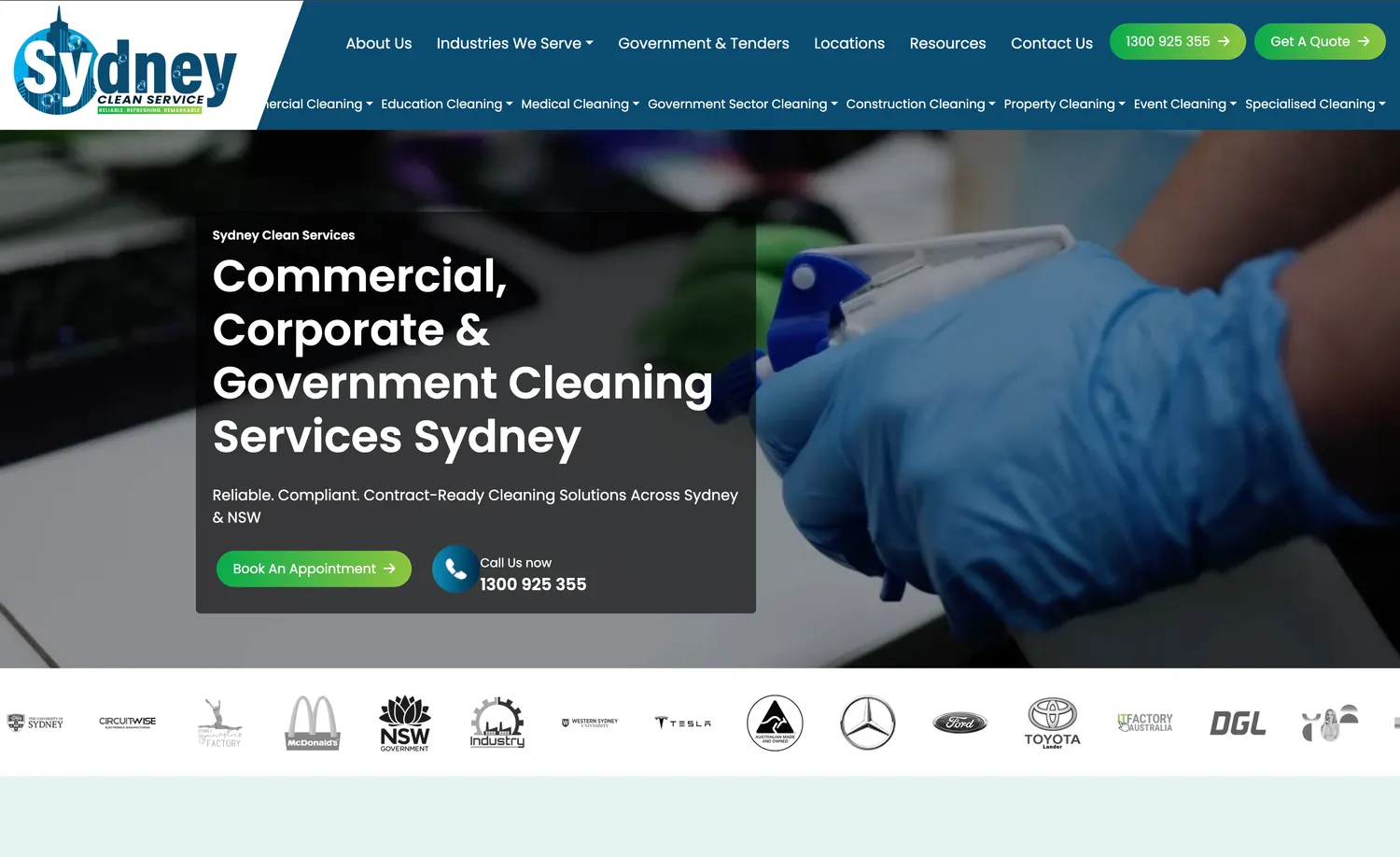
Commercial Cleaning Website Design for a Multi-Sector Sydney Contractor
Sydney Clean Services isn't a home-cleaning outfit with a nice logo. It's a commercial, corporate, and government cleaning contractor serving schools, medical centres, construction sites, and public sector buildings across Sydney and New South Wales. That scope changes what commercial cleaning website design actually needs to accomplish. A homeowner booking a one-off clean and a facilities manager evaluating a WHS-compliant contractor for a multi-site government tender are not reading the same page, and the site had to speak clearly to the second audience without losing the first.
Built on WordPress, the project meant structuring a site around eight distinct service categories — commercial, construction, education, event, government sector, medical, property, and specialised cleaning — each with its own dedicated service page and a set of sub-services underneath. That's a lot of surface area to organize without the navigation collapsing into an unusable mess, and it's exactly the kind of structural challenge that decides whether a service business site converts or just sits there looking professional.
What Sydney Clean Services Focuses On
The business positions itself around compliance and reliability more than price. Their language leans on WHS compliance, police-checked and supervised staff, audit-ready reporting, and contract flexibility — the specific language that facilities managers, procurement teams, and government contract officers actually search for and respond to. This isn't a brand chasing quick, low-value residential jobs. It's built for long-term commercial and government contracts where trust and documentation matter more than a flashy homepage.
That focus shows up in how the site is organized by industries served rather than just services offered. A school administrator looking for education cleaning shouldn't have to wade through construction cleaning content to find what applies to them, and the site's structure reflects that separation clearly, down to sub-categories like childcare and early learning cleaning sitting distinctly from university and TAFE cleaning.
Location Coverage as a Core Structural Element
Because the business serves a genuinely wide geography, from Sydney CBD through Western Sydney, Parramatta, Blacktown, Penrith, the Inner West, and out to the Hills District, location pages became one of the most important parts of the SEO structure. Each region needed enough unique, specific content about the facility types common to that area rather than a templated paragraph with the suburb name swapped in, since search engines and readers both recognize thin, duplicated location content immediately.
WordPress Build and On-Page SEO
The WordPress build prioritized a clean navigation hierarchy that could hold eight service categories, their sub-services, and nearly a dozen location pages without becoming unusable on mobile, which is where most facilities managers do their first search when comparing contractors. Forms needed to work reliably too, since a broken quote request form on a commercial cleaning site doesn't just lose a lead, it can quietly cost a multi-site contract that a competitor's site captured instead.
On the SEO side, the focus keyword and its close variants were placed across the meta title, meta description, URL structure, and the opening section of the homepage and key service pages, following the same discipline I apply to every project: keyword in the first 20 percent of content, density kept in the 1 to 1.5 percent range rather than stuffed, and the focus phrase or a close variant present across at least three H2 headings so the page's structure itself signals relevance, not just the copy.
Writing for a Compliance-Driven Buyer
Service page copy for this project had to do more persuasive work than most cleaning sites attempt. Government and medical clients don't decide based on price alone, they decide based on documented compliance, insurance, and consistency. That meant the content leaned into specifics: fully insured and WHS-compliant service claims, police-checked and trained staff, and transparent pricing structures, written in a way that answers the actual due-diligence questions a procurement officer runs through before shortlisting a contractor.
Internal linking tied every service page back to the relevant location pages and vice versa, so someone searching for medical centre cleaning in Parramatta specifically could land on content that addressed both the service type and the geography in one place, rather than forcing them to piece it together across two generic pages.
Reviews, Trust Signals, and Social Proof Structure
Trust signals matter more on a commercial cleaning site than almost any consumer category, because the buyer is putting their own reputation on the line by recommending a vendor internally. Part of the on-page work involved making sure testimonials, years of experience, and client volume figures were placed where a skimming procurement officer would actually see them, rather than buried at the bottom of a long homepage nobody scrolls to the end of.
Schema markup was applied where the platform supported it, so review content and business information could surface correctly in search results rather than existing only as unstructured text a crawler has to guess at. For a business competing against dozens of similarly named Sydney cleaning contractors, that structured data advantage is often the difference between showing up with rich results and showing up as a plain blue link.
Handling a Site With Deep Navigation Without Losing Users
Eight service categories, dozens of sub-services, and around a dozen locations adds up to a site with real navigational depth. The risk with a structure this size is burying important pages three or four clicks deep, where both users and search crawlers lose patience. The solution was a flattened internal linking approach: every service and location page links back to a handful of closely related pages rather than relying purely on the main navigation menu to carry all the weight.
This kind of internal linking does double duty. It keeps a human visitor from hitting a dead end on any given page, and it distributes link equity across the site so that a newer or less prominent service page still has a reasonable path to being discovered and indexed, instead of depending entirely on its position in a dropdown menu that a crawler might not fully traverse.
A Note on Scale
Eight service categories and around a dozen locations is a lot of surface area for one site to hold without either overwhelming a visitor or diluting search authority across too many thin pages. Getting that balance right — enough depth per page to rank, enough restraint in navigation to stay usable — is the structural work that sits underneath every multi-service commercial site I take on, and it's the piece that most template-based builds skip entirely.
See More
See more multi-service, multi-location WordPress builds in the portfolio, or read the full offer on the WordPress & SEO services page. Running a service business with more than one category and more than one location? Send a brief.